Secular Faith by Mark A. Smith
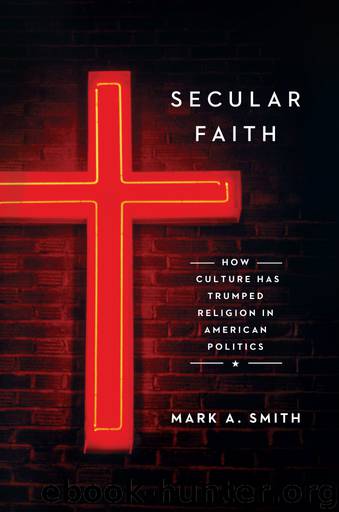
Author:Mark A. Smith [Smith, Mark A.]
Language: eng
Format: epub
ISBN: 9780226275376
Publisher: University of Chicago Press
Published: 2015-08-03T16:00:00+00:00
Abortion and American Culture in the Nineteenth Century
Women during this era obtained abortions prior to quickening through the available methods of the day. Physical techniques such as horseback riding, vigorous jumping, and blows to the midsection were often tried but had a low success rate. If prepared properly, pills or potions derived from herbs such as pennyroyal, hellebore, tansy, savin, and seneca snakeroot were more effective. When they worked, the herbal remedies made a woman so sick that her body expelled the fetus.20 The best techniques were surgical, for a trained practitioner could practically guarantee a successful abortion. As early as 1842 medical professionals began performing abortions with the help of the curette, an instrument for scraping tissue.21 Lacking antibiotics and ignorant of modern antiseptic techniques, however, abortion providers sometimes inadvertently spread infections to the mother that subsequently killed her.22
Given the absence of comprehensive records, it is impossible to know with precision how many women in America obtained abortions in the 1800s. We can gain some clues by considering the demographics of abortion seekers. Writers from early in the nineteenth century noted that abortions were the common recourse of unmarried women who did not marry the fathers of their unborn children. Through rape, seduction, or consensual sex, a man could impregnate a woman and then refuse to marry her. Abortion often became her only alternative to living in poverty and incurring her community’s shame as a fornicator. The doctor who discovered the abortion-inducing properties of seneca snakeroot, for example, wrote that its main users were “women who had indulged in illegitimate love.”23 One of the leading legal authorities on medical practices similarly observed: “The practice of causing abortion is resorted to by unmarried females, who, through imprudence or misfortune, have become pregnant, to avoid the disgrace which would attach to them from having a living child.” The infrequent cases involving married women reflected their desires “to obviate a repetition of peculiarly severe labour-pains, which they may have previously suffered.”24
With the exception of rape survivors, many of them slaves, it was uncommon in early America for single women to become pregnant and then not marry the father. When sex between unmarried partners led to a pregnancy, family and community pressure normally forced the couple to tie the knot. The high number of births occurring within a few months after a wedding testified to what later generations called “shotgun marriages.”25 Such marriages saved the family from disgrace and reduced the demand for abortions. With abortion restricted primarily to single women who did not marry the father, the overall abortion rate must have been low in the American republic’s early decades. An extensive diary from a midwife operating in northern New England from 1785 to 1812, for example, makes no reference to abortion, which suggests it was rare or nonexistent among her clients.26
After 1840, amid westward migrations, urban growth, and the rise of an industrial economy, the demographics and the incidence of abortion shifted. Newspapers carried advertisements from abortion providers who used either surgical techniques or pills and potions.
Download
This site does not store any files on its server. We only index and link to content provided by other sites. Please contact the content providers to delete copyright contents if any and email us, we'll remove relevant links or contents immediately.
| Africa | Americas |
| Arctic & Antarctica | Asia |
| Australia & Oceania | Europe |
| Middle East | Russia |
| United States | World |
| Ancient Civilizations | Military |
| Historical Study & Educational Resources |
Cecilia; Or, Memoirs of an Heiress — Volume 1 by Fanny Burney(32559)
Cecilia; Or, Memoirs of an Heiress — Volume 2 by Fanny Burney(31957)
Cecilia; Or, Memoirs of an Heiress — Volume 3 by Fanny Burney(31943)
The Secret History by Donna Tartt(19097)
Sapiens: A Brief History of Humankind by Yuval Noah Harari(14392)
Leonardo da Vinci by Walter Isaacson(13339)
The Radium Girls by Kate Moore(12033)
Sapiens by Yuval Noah Harari(5374)
How Democracies Die by Steven Levitsky & Daniel Ziblatt(5221)
The Wind in My Hair by Masih Alinejad(5097)
Homo Deus: A Brief History of Tomorrow by Yuval Noah Harari(4921)
Endurance: Shackleton's Incredible Voyage by Alfred Lansing(4785)
Man's Search for Meaning by Viktor Frankl(4608)
The Silk Roads by Peter Frankopan(4537)
Millionaire: The Philanderer, Gambler, and Duelist Who Invented Modern Finance by Janet Gleeson(4481)
The Rape of Nanking by Iris Chang(4217)
Joan of Arc by Mary Gordon(4116)
The Motorcycle Diaries by Ernesto Che Guevara(4105)
Stalin by Stephen Kotkin(3970)
